South Africa’s Industrial Property Market in 2025: A Landscape of Resilience and Opportunity

As the global economic landscape continues its dynamic shifts, South Africa’s industrial property market stands at a pivotal juncture in 2025. Far from merely a collection of warehouses and factories, this sector has emerged as a robust indicator of economic health and a significant driver of growth. Despite lingering global uncertainties and domestic challenges, the market has demonstrated remarkable resilience, consistently outperforming other commercial property types.
This article explores the key trends, performance metrics, and expert insights that are shaping the industrial property market in South Africa for 2025, providing a comprehensive outlook for investors, developers, and businesses.
We will explore the forces propelling its growth, from the relentless surge of e-commerce to the increasing imperative for sustainable development, and examine how these factors are reshaping the demand for modern, efficient industrial spaces nationwide. The narrative that unfolds is one of cautious optimism, underpinned by solid fundamentals and strategic adaptations that position this sector for continued success.
Understanding South Africa’s Industrial Property Market in 2025 is essential for stakeholders seeking to capitalize on upcoming opportunities in this dynamic environment.
Overall Market Outlook: Navigating Economic Currents
South Africa entered 2025 with a sense of cautious optimism regarding its economic trajectory. Forecasts suggested a strong financial year, buoyed by optimistic global market predictions and a strengthening Rand. This sentiment is echoed across the broader property market, which has displayed notable resilience in the early part of 2025, signaling renewed investor confidence. The recovery of listed property funds and declining local long bond yields further underscore this positive shift.
Experts, such as those at Rode, maintain a positive outlook for the remainder of 2025, anticipating moderate economic growth, subdued inflation, and a more favorable interest rate environment compared to 2024. This confluence of factors is expected to create a more conducive climate for property investment and development. However, this optimism is tempered by a realistic acknowledgment of persistent challenges. Global uncertainties, rising operating costs, and the perennial issue of inadequate municipal service delivery continue to pose headwinds.
Furthermore, recent analyses from JLL highlight an uptick in political risk within South Africa, coupled with global economic headwinds that are tempering the overall economic forecast. This has led to a less specific outlook for immediate interest rate cuts, suggesting that consumer and business expenditure may trend sideways in the short term. Unemployment remains a significant concern, standing at 31.9% in Q1 2025, a factor that continues to constrain economic growth.
While CPI inflation is expected to remain relatively stable, a gradual increase is anticipated in the latter half of 2025, with interest rate cuts likely to be deferred until 2026. These broader economic conditions form the backdrop against which the industrial property market operates, influencing demand, investment appetite, and operational costs.
Industrial Property Performance: A Sector in Ascendance
Amidst the broader economic landscape, South Africa’s industrial property sector remains a beacon of stability and growth. Its robust performance in Q1 2025 positions it as the strongest among the three major commercial property types. This ascendancy is primarily attributed to a combination of sustained demand, historically low vacancy rates, and a burgeoning e-commerce sector that necessitates efficient logistics and distribution networks.
Rental Growth: Outpacing Expectations
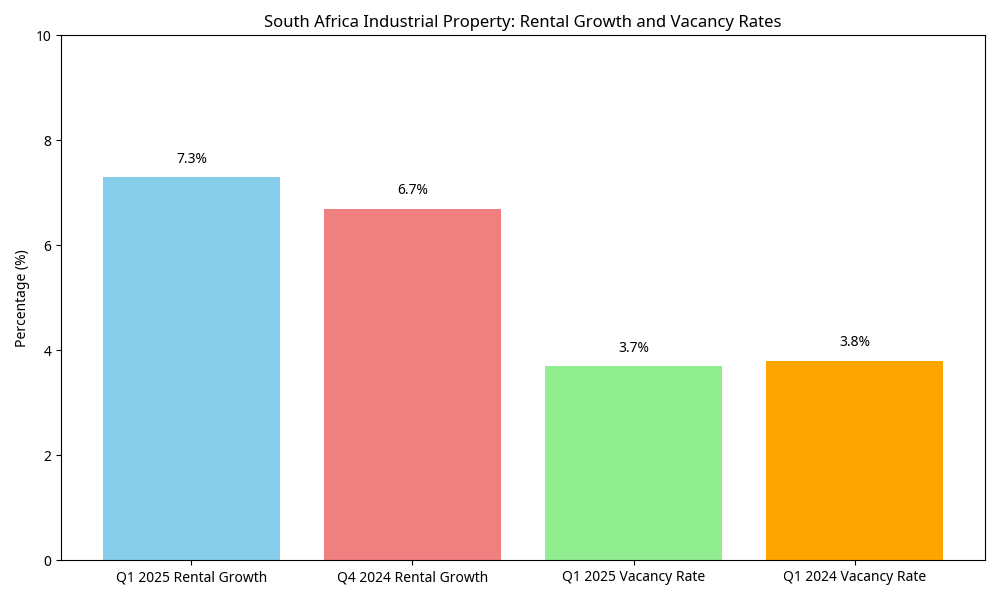
One of the most compelling indicators of the industrial market’s strength is its impressive rental growth. In the first quarter of 2025, nominal gross market rentals for industrial spaces of 500 m² increased by 7.3% compared to the first quarter of 2024. This growth rate not only surpasses pre-pandemic levels but also exceeds the 6.7% recorded in the preceding quarter (Q4 2024), signaling an accelerating upward trajectory. Remarkably, industrial rentals are now approximately 25% higher than their pre-pandemic levels in 2019, a testament to the sector’s resilience and robust demand even in a challenging economic climate..
Geographically, this growth has not been uniform, with certain regions demonstrating exceptional performance. Cape Town, in particular, has emerged as a frontrunner, experiencing double-digit rental growth in its industrial sector during the first quarter of 2025. This strong performance is indicative of the city’s growing importance as a logistics and distribution hub, attracting significant investment and development. Other key industrial nodes, such as Central Witwatersrand and the East Rand, also recorded solid rental growth of approximately 7%, further solidifying the positive outlook for the sector across diverse economic centers.
Vacancy Rates: A Tight Market
The robust rental growth in the industrial sector is directly correlated with its consistently low vacancy rates. In Q1 2025, the average vacancy rate for the industrial sector was 3.7%, a slight decrease from 3.8% in Q1 2024. This figure is particularly noteworthy as vacancy rates have remained remarkably stable, hovering just under 4% for the past two years. Such low vacancy rates indicate a tight market with limited available stock, which empowers landlords and drives rental increases.
The situation in Cape Town exemplifies this trend, where vacancy rates in most major industrial areas are reported to be very low, resulting in the quick absorption of available properties and minimal opportunities for rental discounts. This scarcity of prime industrial space underscores the strong demand and the need for continued development to meet market needs.
Other Relevant Trends: Reshaping the Commercial Property Landscape
The dynamism is not occurring in isolation; it is part of a broader transformation across the commercial real estate sector. Several interconnected trends are reshaping demand and development, influencing how businesses operate and how properties are designed and utilized.
Office Spaces: Redefining the Workplace
The traditional office space is undergoing a profound metamorphosis, driven by the widespread adoption of hybrid work models. In 2025, new and improved commercial office spaces are being redesigned to cater to modern business needs, offering high-end facilities such as relaxation pods, co-working hot desks, communal boardrooms, and pop-up food and beverage stations.
This evolution is leading to an increase in mixed-use developments, where innovative property dynamics are combined with classic appeals, such as ample parking, creating environments that seamlessly integrate work, leisure, and convenience. While the focus of this article is on industrial space, the shift in office space utilization indirectly impacts industrial demand by influencing urban planning and the overall commercial ecosystem.
Warehousing: The Backbone of E-commerce and Sustainability
The surge in online shopping, particularly evident during festive seasons, has unequivocally highlighted the escalating demand for warehouses and distribution centers. As e-commerce continues its relentless expansion, the need for efficient and strategically located logistics infrastructure becomes paramount. Beyond mere storage, modern warehousing is increasingly focused on sustainability.
Business owners and tenants are actively seeking spaces that are energy-efficient, solar-powered where possible, and incorporate eco-friendly initiatives such as water-saving, waste reduction, and recycling methods. This growing awareness of environmental impact is transforming warehouse design and operation, making green credentials a significant factor in property selection.
Retail Centers: Experiential and Integrated
Consumer behavior is a powerful catalyst for change, and as shopping demands evolve, the industrial property market adapts to meet these new needs. In 2025, the retail market is transitioning into an era defined by experiential shopping, prioritizing convenience, and seamless e-commerce integration.
Lifestyle shopping destinations have become a prominent trend, offering a holistic, one-stop solution that combines retail with food, wellness, beauty, and entertainment options. While physical stores remain popular, the underlying logistics and supply chain demands generated by this hybrid retail model directly fuel the need for sophisticated industrial spaces, from last-mile delivery hubs to large-scale distribution centers.
Green Buildings: A Global Imperative
Sustainability is no longer a niche consideration but a crucial imperative shaping the future of real estate. For South Africa, a developing country with immense potential, adherence to environmental, social, and governance (ESG) indicators is non-negotiable for the industrial property market moving forward. The emphasis on sustainable design, reducing carbon footprints, and prioritizing community upliftment is vital for achieving long-term success.
Industrial buildings designed with these principles in mind are increasingly attractive to quality buyers and tenants who are committed to transforming the perception of industrial construction and its environmental impact. This trend not only aligns with global best practices but also offers tangible benefits in terms of operational efficiency and long-term value.
Expert Opinions and Forecasts: Charting the Future Course
The collective wisdom of industry leaders paints a compelling picture for the industrial property market in 2025. This optimistic outlook is grounded in the industrial property sector’s consistent outperformance, driven by a trifecta of intense demand, limited supply, and rising construction costs.
Looking ahead, a further reduction in the repo rate is anticipated, a move that is expected to foster a delicate balance between affordability and technological innovation within the market. This interest rate environment, coupled with a growing focus on sustainable development, is likely to encourage more green investments and practices across the industrial landscape.
South Africa is also poised to make a significant mark on the global stage, with projections indicating it will become the tenth-largest photovoltaic market worldwide. This surge in solar energy adoption will undoubtedly enhance the resilience of businesses, particularly those operating within energy-intensive industrial facilities.
The evolving nature of business operations is also influencing property trends. The rise of short-term leases is expected to stimulate demand, particularly for B-grade properties, providing businesses with flexibility in a dynamic economic environment. The relentless expansion of e-retail sales, projected to exceed $26 billion by 2025, will continue to profoundly impact traditional brick-and-mortar properties, further solidifying the need for robust logistics and distribution infrastructure.
This burgeoning e-commerce ecosystem is expected to drive increased demand for industrial, office, retail, and logistics asset classes, potentially leading to the adaptive reuse of suburban areas and even underutilized cinema complexes to accommodate this evolving demand.
Moreover, the forecast indicates a significant increase in construction activity, driven by a rise in public-private partnerships. This collaborative approach is expected to attract further investment into the sector, fostering a renewed sense of optimism within the commercial real estate market. As this sector continues its upward trajectory, landlords are poised to enhance their financial standing, benefiting from the sustained demand and appreciating asset values.
The confluence of these expert opinions and forecasts suggests a future where South Africa’s industrial property market not only sustains its current momentum but also adapts and innovates to meet the demands of a rapidly changing economic and technological landscape.
Conclusion: A Resilient Future for South Africa’s Industrial Property
Despite a backdrop of global economic uncertainties and domestic challenges, the sector has not only maintained its stability but has also demonstrated robust growth, particularly in rental values and consistently low vacancy rates. The driving forces behind this performance are multifaceted, ranging from the sustained boom in e-commerce and the consequent demand for efficient logistics infrastructure to a growing emphasis on sustainable and green building practices.
As we navigate through 2025, the industrial property market is poised to continue its outperformance, attracting both local and international investment. The strategic shifts towards modern, energy-efficient warehousing, the evolution of retail into experiential hubs, and the innovative redesign of office spaces all contribute to a dynamic real estate ecosystem where industrial properties play a central and increasingly vital role. While challenges such as high unemployment and the need for improved municipal services persist, the proactive embrace of new technologies, sustainable development, and strategic partnerships offers a clear path forward.
Insights from leading industry experts underscore a collective optimism, highlighting the sector’s capacity for continued growth and its potential to make a significant contribution to South Africa’s economic prosperity. For investors and businesses looking to capitalize on this vibrant market, understanding these underlying trends and adapting to the evolving demands for modern, efficient, and sustainable industrial spaces will be key to unlocking long-term value and success in the years to come.
References
JLL. “South Africa Industrial Market Dynamics, Q1 2025.” JLL, https://www.jll.com/en-us/insights/market-dynamics/south-africa-industrial
Currie Group. “Trends in South Africa’s Commercial Property Market in 2025.” Currie Group, 2 Jul. 2025, https://curriegroup.co.za/south-africas-commercial-property-market-in-2025/
Propertywheel. “The State of SA’s Property Market in Q1 2025.” Propertywheel, 30 May 2025, https://propertywheel.co.za/2025/05/the-state-of-sas-property-market-in-q1-2025/